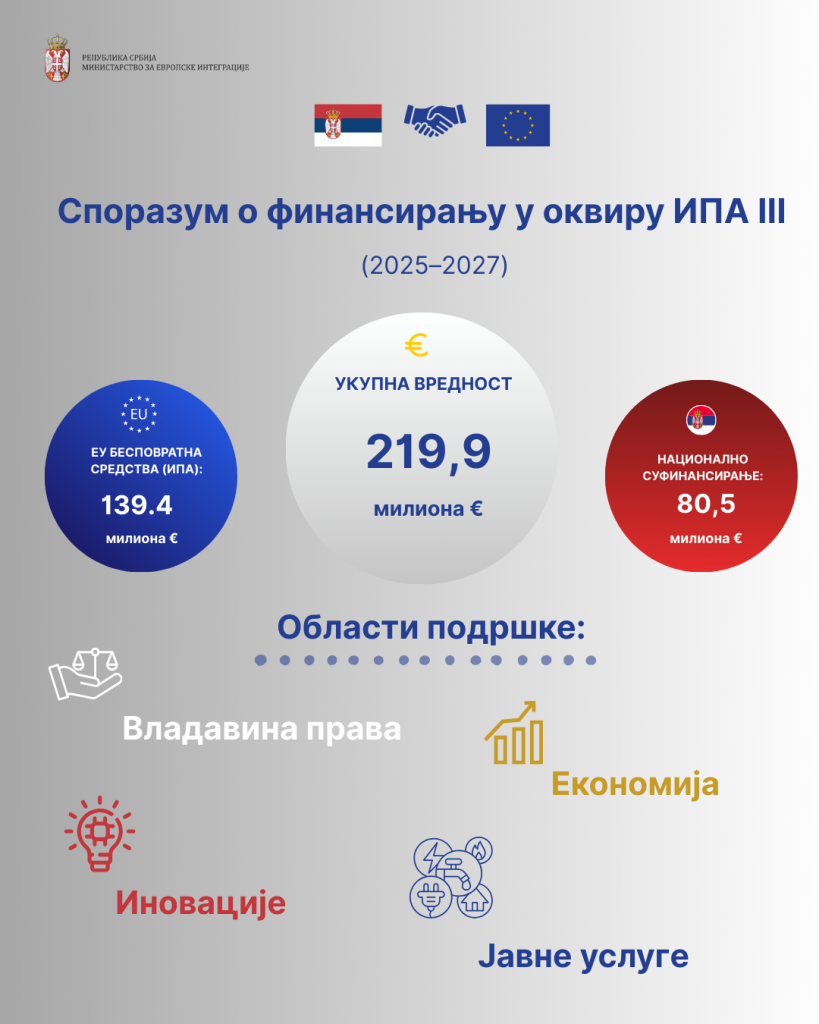
Republic of Serbia and European Union have signed a €219.9 million Financing Agreement under the Instrument for Pre-Accession Assistance (IPA III) for the 2025–2027 period, with €139.4 million provided as non-refundable EU grants.
Serbia will contribute an additional €80.5 million to support the implementation of key projects, underscoring its commitment to working alongside the European Union on reforms aimed at delivering tangible improvements to citizens’ lives.
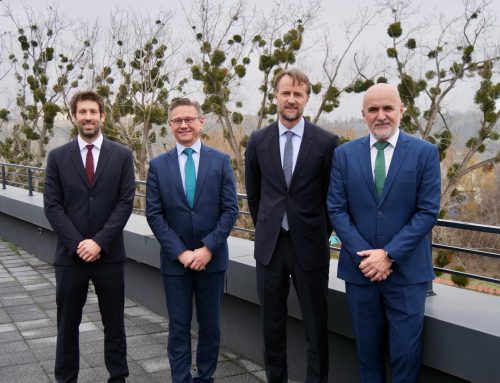
Agreement was signed on behalf of Serbia by State Secretary at the Ministry of European Integration and National IPA Coordinator Mira Radenović Bojić, while Valentina Superti, Director for the Western Balkans at the European Commission’s Directorate-General for Neighbourhood and Enlargement Negotiations, signed on behalf of the European Commission.
“This agreement is not merely a financial framework; it is a joint message from Serbia and the European Union that we want to ensure a safer, fairer and more promising future for our citizens,” Radenović Bojić said. She stressed that the support enables the continuation of reforms that strengthen institutions, improve public services and drive progress across all parts of the country. “It is an investment in a Serbia that is moving forward, relying on knowledge and innovation, and where citizens can feel the concrete results of our joint efforts,” she added.
The overarching objective of IPA III is to support beneficiaries in implementing the political, institutional, economic and social reforms required to align with EU values and rules and ultimately achieve EU membership. The European Parliament and the Council of the EU adopted the regulation establishing IPA III in 2021 for the 2021–2027 period.
“The European Union wants Serbia to join our community as a fully democratic state,” said EU Ambassador to Serbia Andreas von Beckerath. “EU pre-accession assistance is designed to help Serbia strengthen its democratic institutions, advance key reforms and prepare to fully benefit from EU membership. We want a strong Serbia in our European family, and we will continue to stand by it at every step of the accession process.”
The agreement provides support across key areas including the rule of law, good governance and economic development. Planned measures include strengthening systems for supporting victims and witnesses, continuing the fight against corruption and various forms of crime—including environmental crime—protecting fundamental human rights, and providing legal assistance to internally displaced persons. The agreement also ensures continued backing for the EU integrationus process and further alignment with EU legislation.
Particular emphasis is placed on creating an enabling environment for small and medium-sized enterprises, fostering local development, and promoting science and innovation at the local level.
The agreement reaffirms the importance of EU support for Serbia, enabling further development through investments in innovation, digital transformation, improved public services and local infrastructure. At the same time, it contributes to better protection of vulnerable groups and farmers by gradually aligning with European standards and enhancing the quality of institutional services.