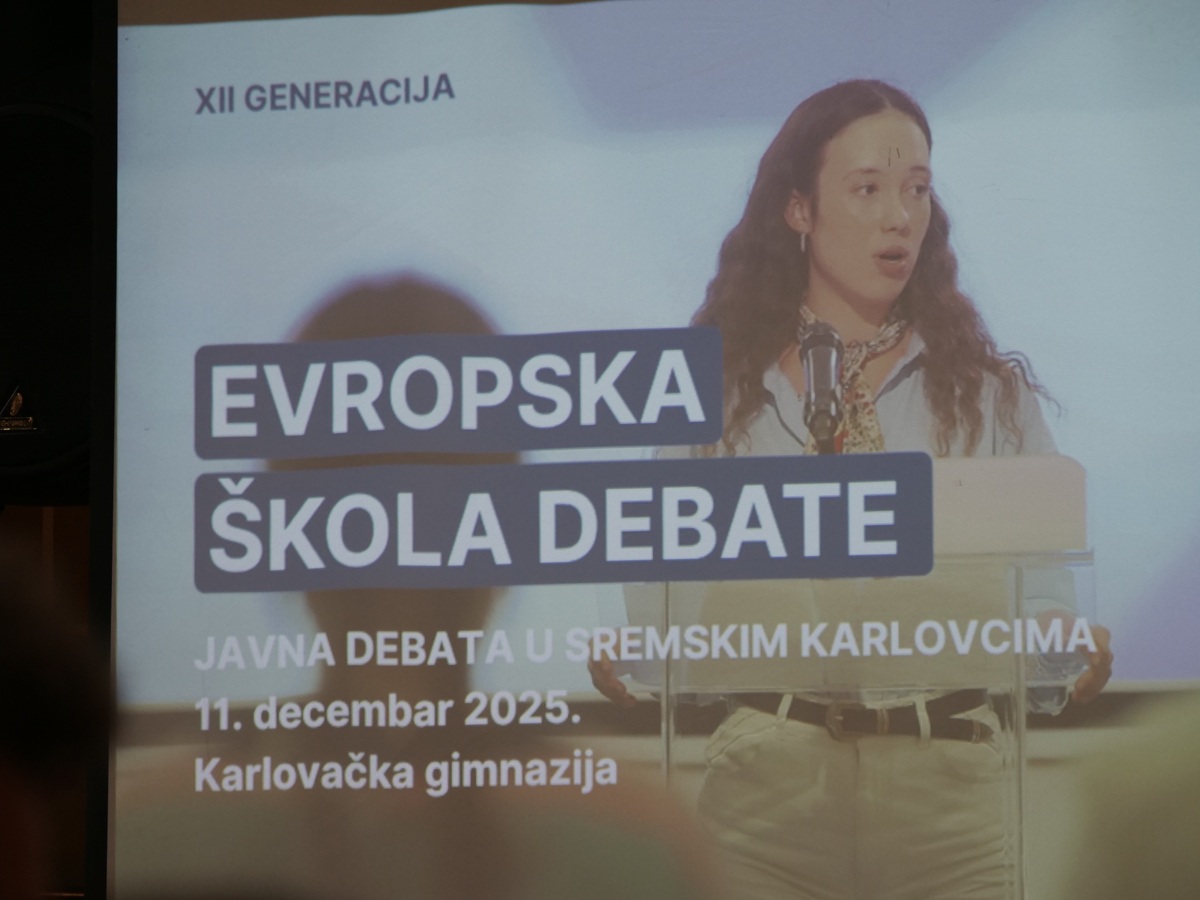
Sremski Karlovci hosted on December 11 the second public debate of the 12th generation of the European Debate School, an educational program jointly organized by the Europe House and the Open Communication debate network, with support from the EU Delegation to Serbia.
The debate took place at the Karlovac Gymnasium and brought together high-school and university students who completed an intensive four-day debate training program in November at the Europe House in Belgrade.
Participants included students from the Karlovac Gymnasium, the “Jovan Jovanović Zmaj” Gymnasium in Novi Sad, and the Faculty of Philosophy at the University of Novi Sad. Their task was to present well-reasoned arguments defending opposing positions on the motion: “This House believes that families should have access to and ownership of all digital content and information belonging to their children until they turn 16.”
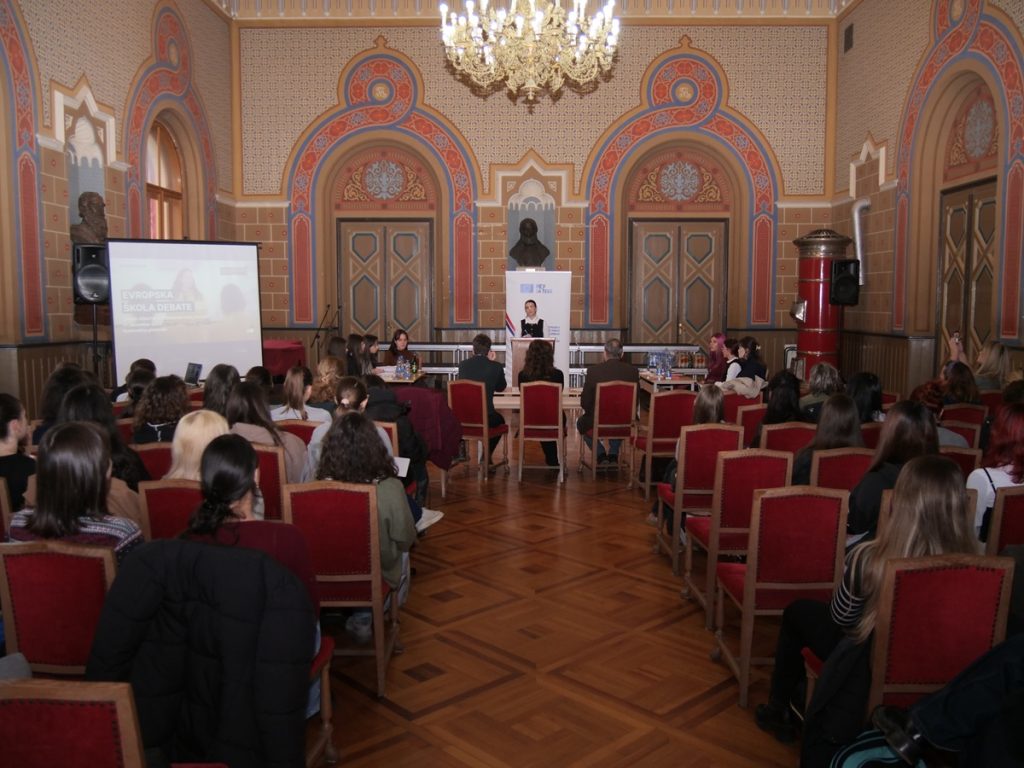
The topic opened up a range of ethical and legal dilemmas—from parental responsibility and online safety to privacy protection, autonomy, and the trust between children and parents. Audience had the opportunity to follow a dynamic exchange of arguments, learning both about the rules of contemporary academic debate and about techniques for constructive argumentation.
The winner was initially supposed to be selected by a three-member jury composed of Lazar Popović, debate coach at Open Communication; Dr. Albina Milanov-Stajkečić, instructor of rhetoric and public speaking; and Prof. Dr. Srđan Damjanović, professor of philosophy. However, after the jury was unable to reach a final decision, the vote was handed over to the audience, which awarded victory to the government team by majority vote.
One of the participants, who took on the role of the deputy prime minister in the debate, noted that the structure of the motion itself gave an advantage to the opposition team, although the contest remained tightly competitive.
“I agree with the jury that the debate was, in a way, naturally tilted toward the opposition—its side had more intuitive arguments—but I think we put in a great effort. It was a very close debate, and both teams delivered equally strong performances. I wasn’t stressed about who would win—I came here to enjoy the experience,” she said.
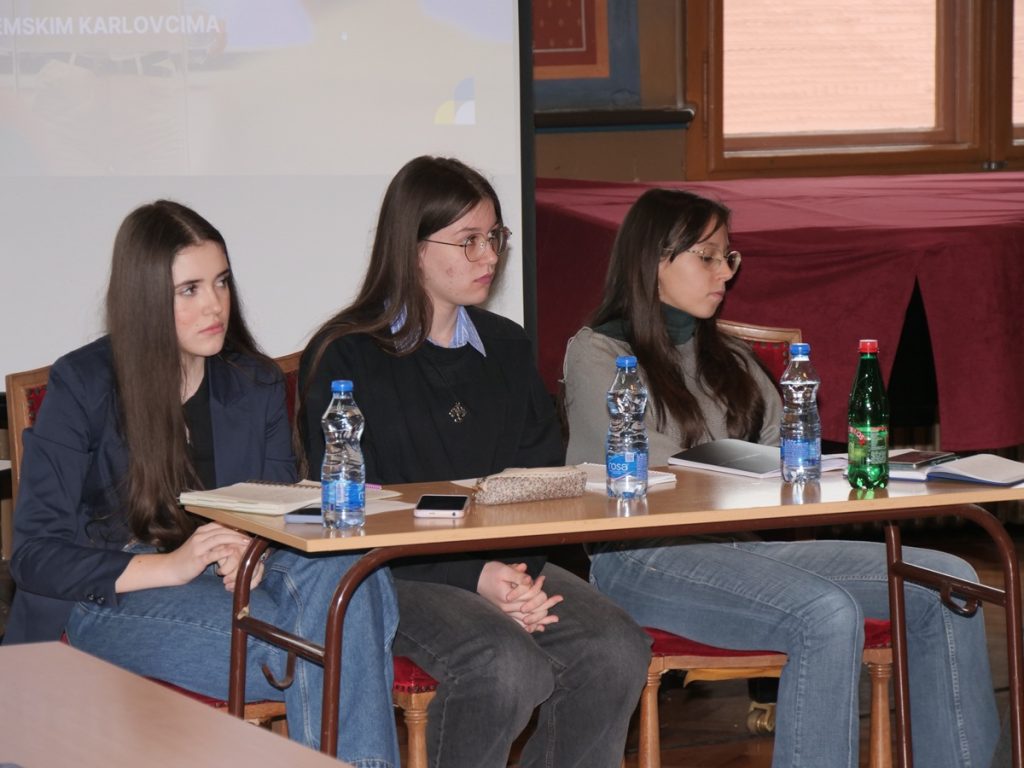
Professor Srđan Damjanović emphasized that the jury faced a serious challenge.
“It was extremely difficult to decide between the government and the opposition because they had different tasks, positions, and roles, yet an equally strong ability to shape their arguments logically and coherently. The audience’s vote was largely unexpected and prompted the jury to further reflect on its own position.”
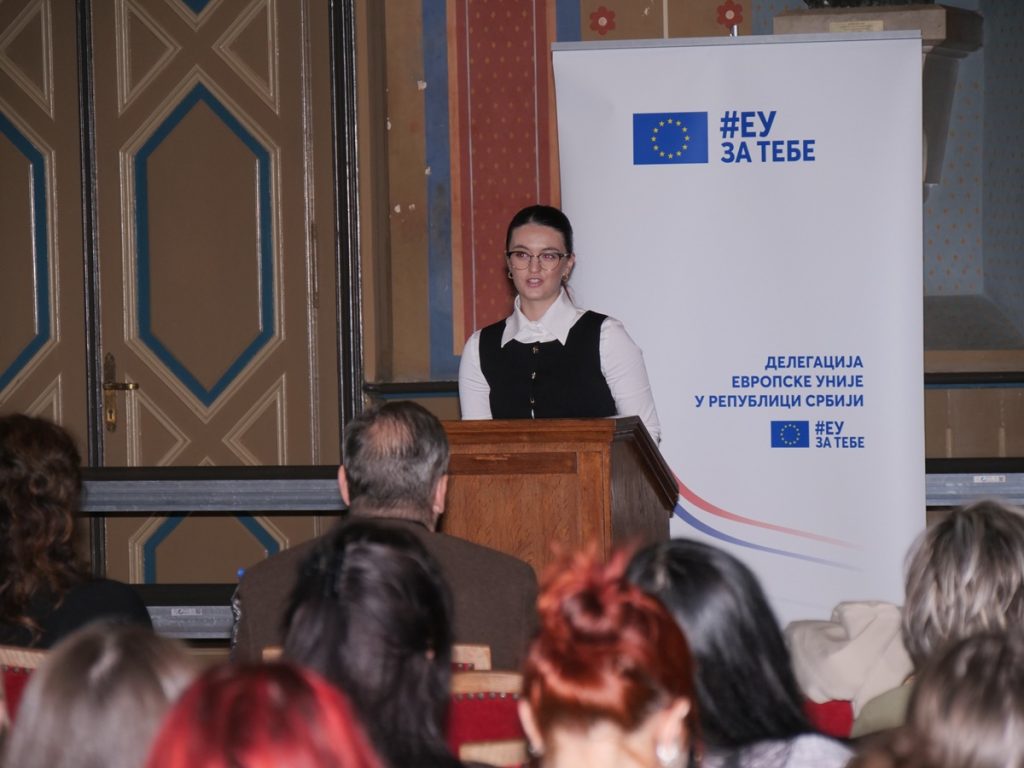
European Debate School is a long-running educational project implemented by the Europe House and the Open Communication academic debate network, with support from the Delegation of the European Union to the Republic of Serbia.
The project aims to equip high-school and university students with skills in debating, argumentation, critical thinking, and public speaking, while also familiarizing them with the European Union, its institutions, and the process of European integration.
Over the past eleven years, more than 1,000 young people from over 30 cities across Serbia have taken part in the program, and around 50 public debates on current social issues have been organized.